It is a rare opportunity that a master Technic Lego builder shares the “tricks of the trade” in an easily accessible book form. Sariel is such a master, well-known and respected for his amazing Lego Technic creations which he documents on his website http://sariel.pl. Sariel’s creations are the most-viewed Technic model videos on YouTube, and his work has been the basis for many great vehicles built by others.

Sariel’s book is published by NoStarch press, and you can order a copy online at http://nostarch.com/technicbuilder.

As soon as he announced that he was publishing a book I pre-ordered a copy for myself. I was lucky enough to receive a pre-publication copy for review and also the physical copy I ordered myself. Below is my review…
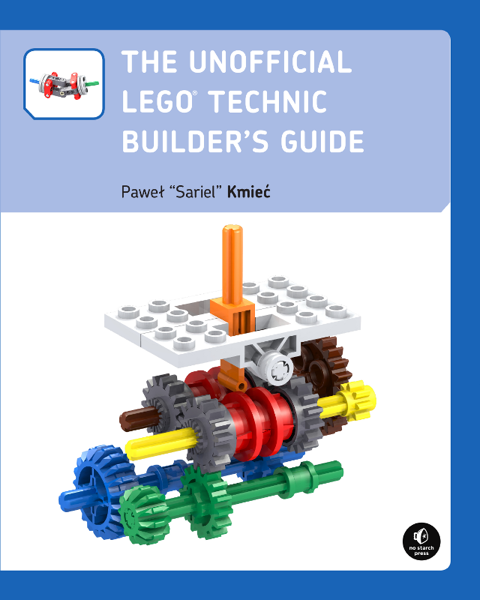
Unofficial lego builders guide

Overview of the book

The book is of a very high quality, with colour graphic images interspersed with text. This is a big improvement over a black-and-white printed book. Sariel has broken the material down into five core sections:

  1. The basics (always good to start with this!). In this section the chapters cover the basic geometry of Lego, both studded and stud less. This is familiar territory for anyone who has been building Lego for some time, but it’s good to see it given an in-depth treatment. I tend to build stud-less, and it was valuable for me to see an analysis of the pros-and-cons of studded vs. stud-less building.
  2. Mechanics. Making stuff go is what makes building Lego fun! To achieve this you need to understand the principles behind transmissions, gears, pulleys, levers and linkages. This was one of my favourite sections, especially the chapter on levers and linkages.
  3. Motors. Lego has released many motors over the lifetime of the product and it’s important to know what is the best motor to choose for a given task. Sariel has done a nice job of summarising the torque and speed of each motor available.
  4. Advanced mechanics. Ah you knew the word “advanced” had to show up at some point right? Now we get into the material like how to build steering systems, transmissions, gearboxes and chassis. If you’ve followed Sariel’s work you’ll know that he understands how to push Lego Technic to the limit, and the chapters in this section let this show through. The full-colour illustrations really help in this section given the level of detail presented.
  5. Models. Don’t expect building instructions for huge models here - in this section Sariel explains how he approaches the design and scaling of a new model, giving us an insight into his thought processes.
There is a lot of material here, some of it is covered in great depth and some at a high level. No matter how long you have been building Lego you will learn something. Pick the area that you find yourself struggling with and then study that section in the book. Building instructions are given for some of the concepts shown to help you get started.

What I liked

  • A full colour production - and the paper is of high quality. This is a book that will stay close during my Lego building.
  • Breadth of the subject material - a lot is covered.
  • Good discussion on transmissions and gearboxes.
  • Addressing the pros-and-cons of studded vs. stud less building.

Conclusions

In every field there is a well-thumbed copy of a book that sits besides every workbench or table; this is the book for Lego builders. Alongside Isogawa-san’s amazing Toro-no-maki this book is going to be a reference I’ll use during every building session.

Good job Sariel - play well!

 
Tagged with:  

World Robot Olympiad 2012

On 20/11/2012, in Events, News, by Mark
 

World Robot Olympiad 2012, Kuala Lumpur Malaysia
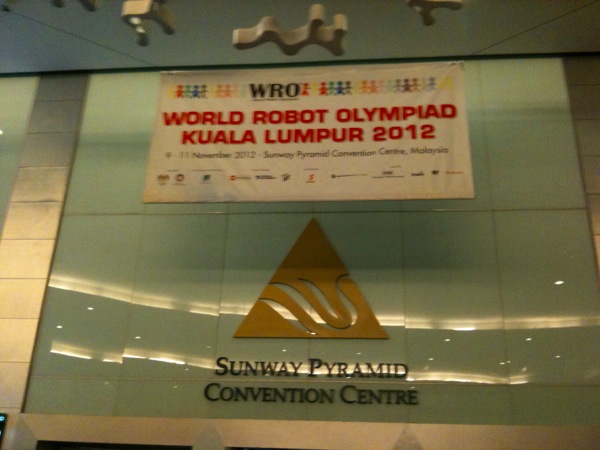
IMG 1005
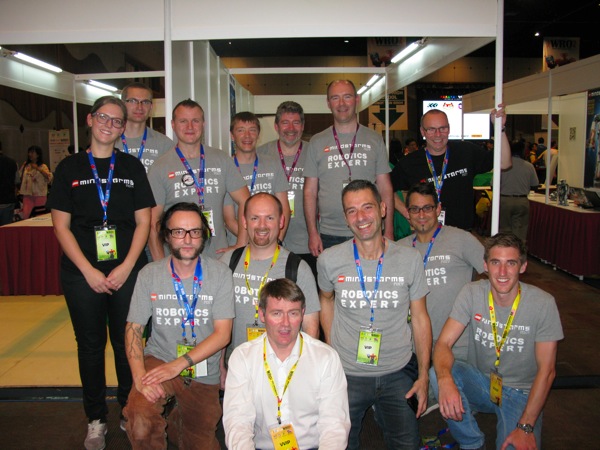
The World Robot Olympiad was held this year in Kuala Lumpur Malaysia, at the Sunway Resort Convention Centre. Four hundred teams of children from 34 countries competed in challenges to build robots to solve complex problems. I was lucky enough to be invited as a guest of Lego to present my latest invention; SoundMachine. We were the “robotics experts”, which I always find a humbling title as I consider myself far from expert in building robots :)
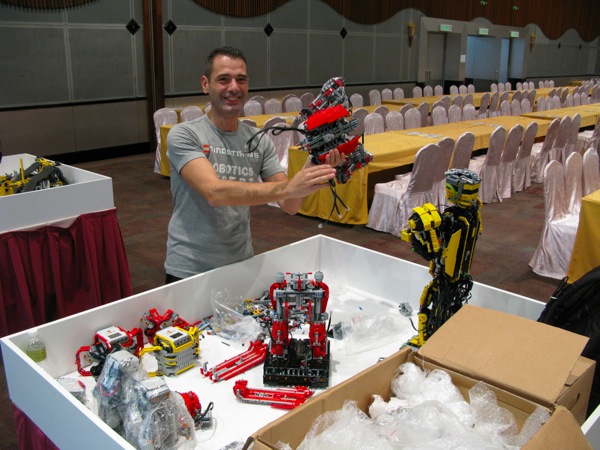
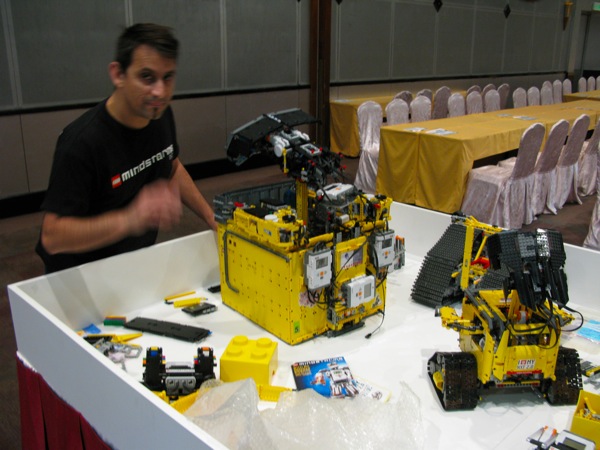
I was lucky enough to meet up with fellow Lego Mindstorms enthusiasts from around the world. This year we had in attendance
  • NeXTStorm and his amazing boxing robots
  • Bazmarc and WallE
  • Mathias Paul Scholz with his robot shadow puppet theatre and NXT biker gang
  • Simon Burfield and his new robotic wheelchair strong enough to carry an adult
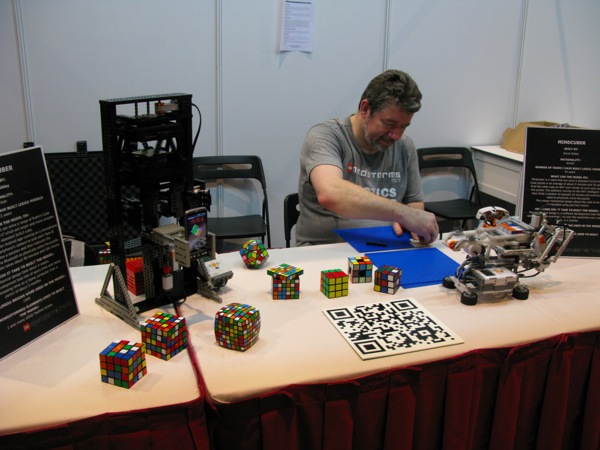
  • David Gilday and Mike Dobson with their Guinness world record holding Rubiks cube solvers
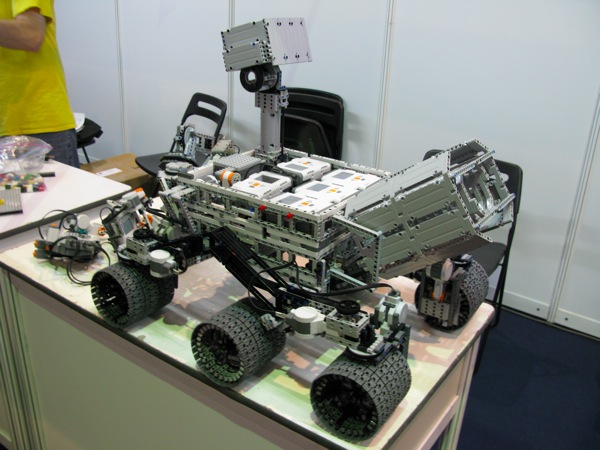
  • Will Gorman with his 3D Lego maker bot and Mars Curiosity rover
  • Lasse Laussen and Ken Madsen with their flying Lego blimp C5
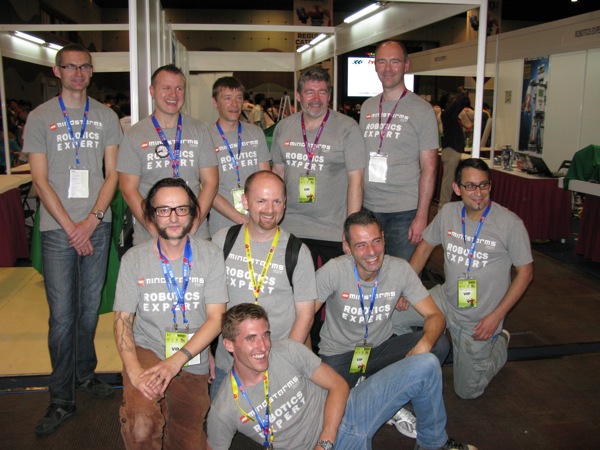
IMG 1284
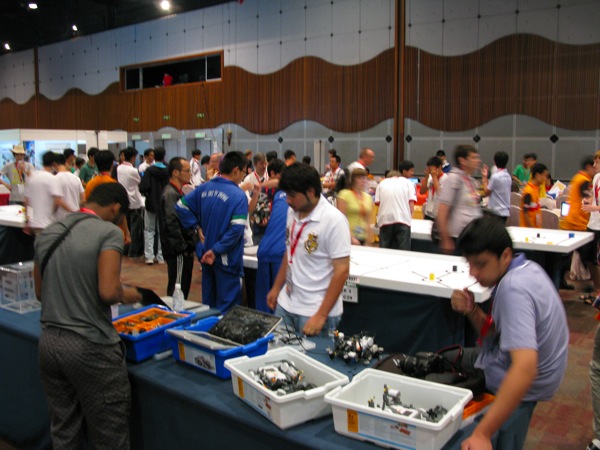
This year’s event was even bigger than last year in Abu Dhabi. There were more countries represented, more teams in attendance and definitely more people passing through the exhibit hall to see what all the fuss was about. We were kept on our feet for the duration of the event with kids (and parents) eager to see how they could build cool inventions using Lego Mindstorms.
SoundMachine was a big hit, and I was very pleased with how the kids took to building music using Lego. I was challenged with finding a combination of instruments which sound good together. Almost everyone who played with SoundMachine filled an entire Lego plate with bricks, which generally gave a very noisy final result that sounded very little like music. Definitely something to improve.

Day 1 - Deepavali

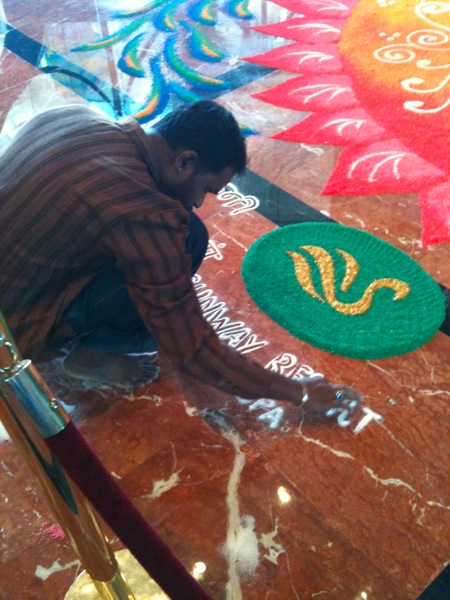
We had arrived a few days ahead of the event so that we could go sightseeing and acclimatise to the hot humid Malaysian weather. The Deepavali ceremony was coming up, and fresh flowers were being laid out around the hotel and in the adjoining mall to celebrate the festival of light. Most impressive was a hand-made sand painting on the floor of the hotel lobby. We watched as the artist painstakingly laid out a sand picture approximately 5m square using vividly colour sand. It takes him about four hours to make one picture we were told. I hate to think how he feels when the hotel finally sweeps away his hard work!
IMG 0902IMG 0901IMG 0899IMG 0908

Day 1 - Setup

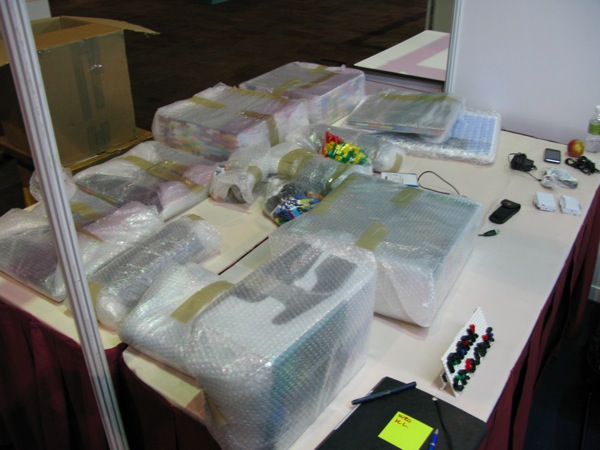
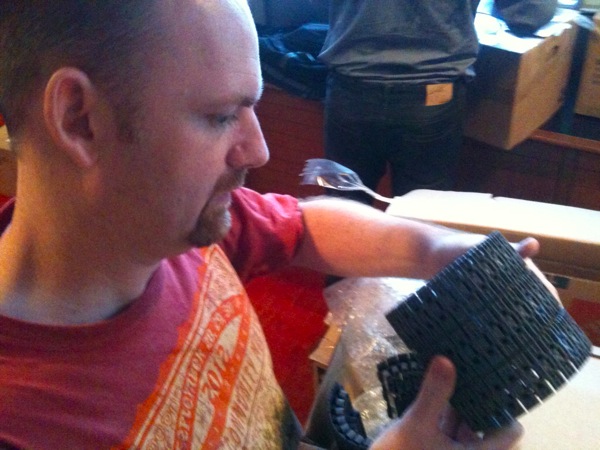
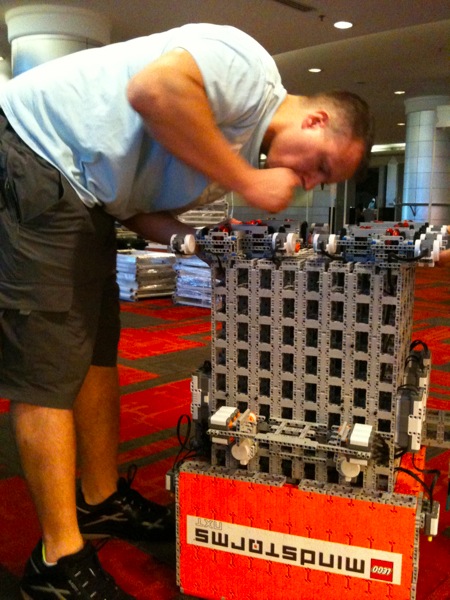
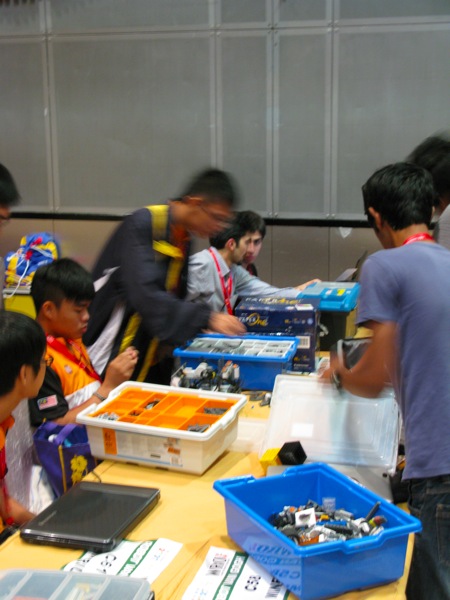
The LEGO experts and myself gathered in the Sunway convention centre to answer the question that had been plaguing us for the previous month; had our precious boxes of LEGO models arrived in one piece? Or were we going to open our boxes to a pile of bricks?
I find out just how well I packed my kit.
IMG 1171
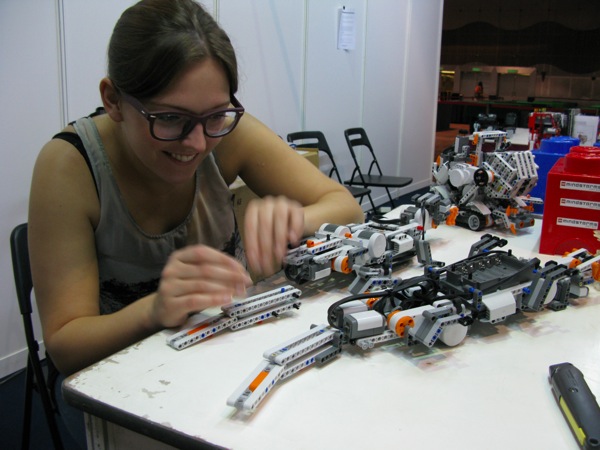
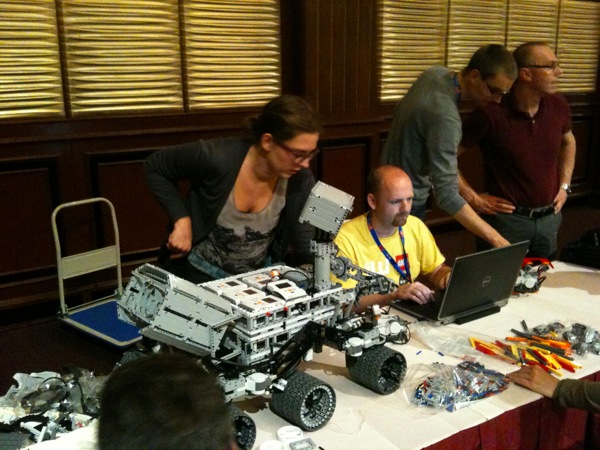
Marie the expert robot builder repairs a RoboGator.
IMG 1173
Will checks his rover wheels.
IMG 0926
Will’s Mars rover arrived intact across interplanetary space.
IMG 1174
Vas putting together the boxing robots.
IMG 1177
Wall-E needs a little help!
IMG 1178
David putting together the Rubiks cube solving robots - MindCuber and CubeStormer.
IMG 1179
Simon making sure the Lego wheelchair can hold his weight.
IMG 0937
Thankfully there was not too much damage from shipping. My SoundMachine boxes were well packed, and only suffered some slight cracking which was easily fixed. A few hours later and I had my booth ready to go.
IMG 1193
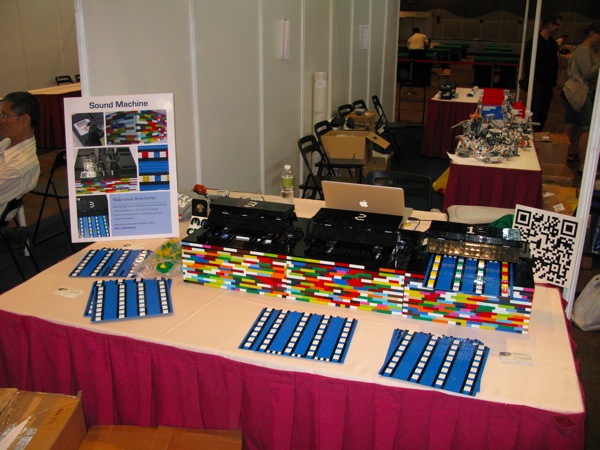
I arranged the SoundMachines on the table with space for kids to build using the bricks on the plates. I hid my speakers behind the units and crossed my fingers… would it work?
The robotics experts after a long day building our models on the stands.
IMG 1287

Day 2 - Opening Ceremony

The opening ceremony kicked off the event, and the LEGO Robotic Experts had a part to play! The Deputy Prime Minister of Malaysia was to open the event and Steven from LEGO wanted to do something cool; how could we get some LEGO robots involved in the opening ceremony? A crazy plan was hatched; the Deputy PM would press a button on a LEGO remote which would then trigger the Mars Rover (built by Will) to turn and flash its lights at the LEGO flying blimp (built by Lasse and Ken). The blimp would then take off and fly over the head of the audience to fire a “laser” at a target on the screen marking the official kick-off of WRO 2012. It all sounded so simple when Steven described it to us the night before…
IMG 0966
Late-night hackathon reprogramming a Mars rover.
You often hear of the “man behind the curtain” at these technology demos, made famous by the scene in the movie the Wizard of Oz. This was my turn, along with Will, to be the man behind the curtain. The complex sequence of movements that the rover needed to perform could only be achieved if two people were controlling it. Will and I stood behind a curtain with ours hands perched over our remote controls for almost two hours while we waited for our critical moment.
IMG 0981
Here you see children from Malaysia performing the traditional welcome dance.
IMG 1240
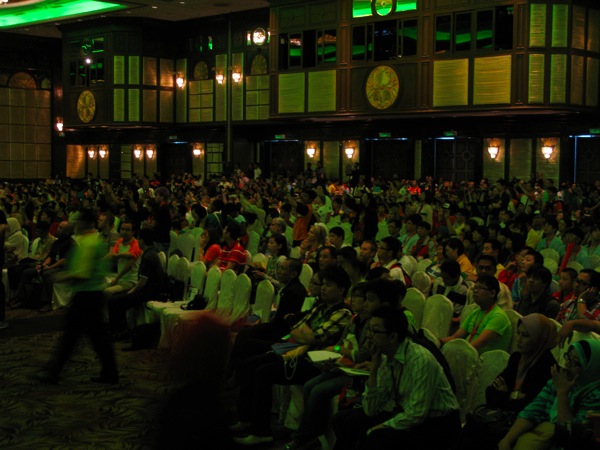
The crow assembled - the hall was full of noisy anticipation!
IMG 1251
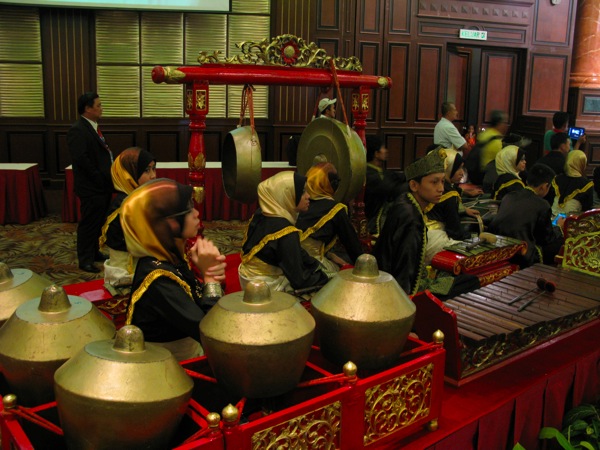
A traditional Malay music band performing.
IMG 1261
The country representatives gather on stage
When the time came the DPM was handed a remote control which we built the night before, and as Will and I watched for the lights on the remote to flash… they turned out all of the lights in the room and started flashing strobe lights!
Thankfully we were able to manoeuvre the Rover in the dark with no clear vision and pull off an impressive opening sequence. I now have great respect for the NASA engineers who drive the real rovers on far-off worlds!

Day 2 - Let the madness begin!

IMG 1199
The first day of the robotics competition was madness. On my first day I ran SoundMachine 620 times! By the end of the day I was knackered and delighted in how well SoundMachine performed. I was competing with the overly loud music being broadcast in the hall (we had to shout to be heard over the music) but people still got to experience the joy of “building” music.
One thing became quickly apparent to me; kids wanted to fill the entire plate with bricks which created a terrible noise once it was scanned in. When I designed SoundMachine I assumed that people would put a few bricks on each track to see how it sounded and then add more bricks. My assumption was not a good one!
IMG 1270


WRO Competitions

The WRO main event was composed of a series of robot challenges, and the teams that solved the challenges the fastest scored the most points.
IMG 1209
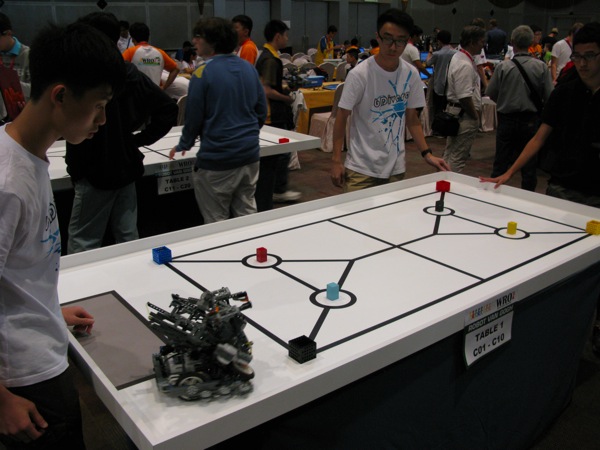
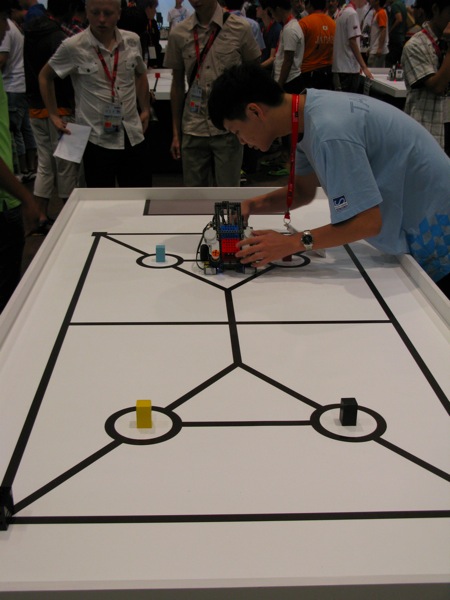
In the Robot Van Gogh challenge teams had to move pieces around a playing field to match coloured blocks to their correct location. This is not an easy problem to solve, especially if your robot is moving fast.
IMG 1220
IMG 1229
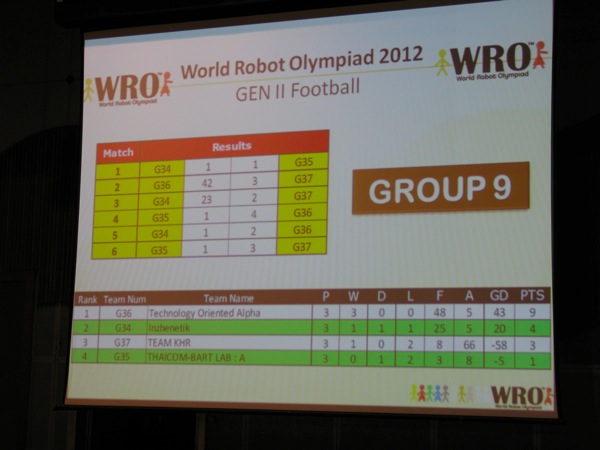
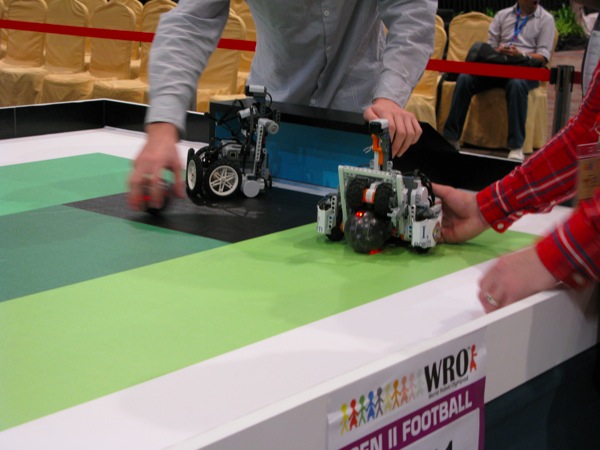
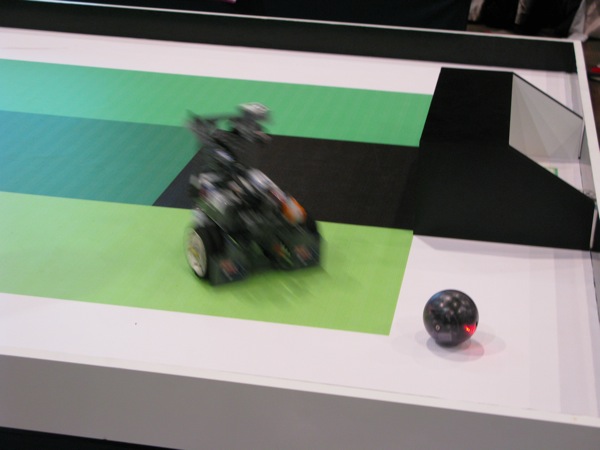
Robot table soccer was another competitive event, with robots chasing a IR beacon as a ball.
IMG 1225
IMG 1224
These robots move fast!

Despite being young all of the competitors took the event very seriously. They had won their national championships and were representing their home countries. This was a real competition with national pride at stake!
IMG 1231
IMG 1230
IMG 1226

Day 3 - Saying goodbye

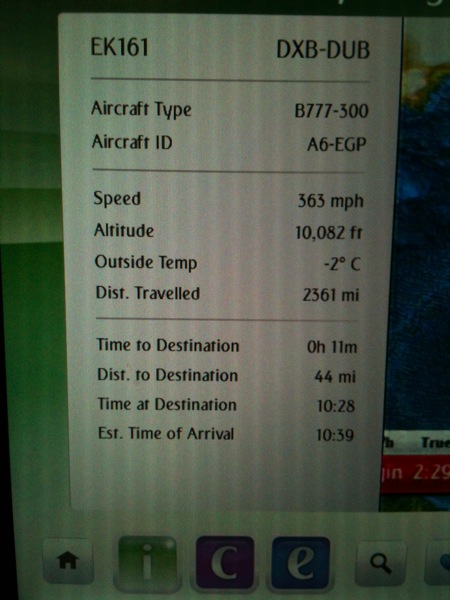
All good things must come to an end, and the WRO 2012 was no exception. On Sunday we ran another series of demos for the models and then at lunchtime had to pack up. It was a big rush for me to pack my models, grab some lunch, pack my suitcase and head to the airport. We had 25 hours of traveling ahead of us with a stop-over in Dubai.
IMG 1017
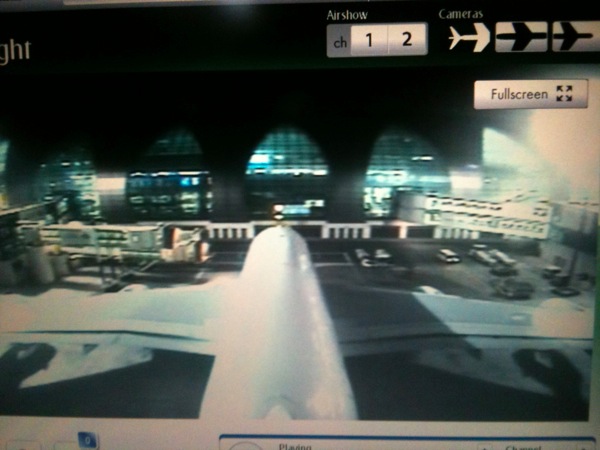
View from the tail-camera of the plane as we left Dubai airport.
IMG 1018
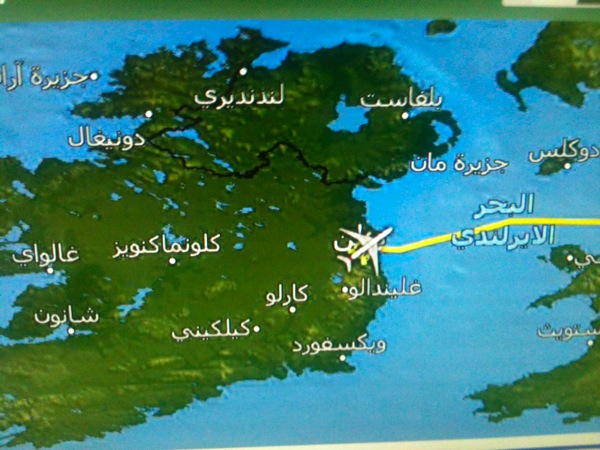
A long way still to go home
IMG 1027
Almost there!
IMG 1030
Home at last
It was an amazing experience to attend WRO and already my head is swimming with ideas for next year’s event if I am lucky enough to be invited. Roll on 2013!
 
Tagged with:  

NXT breadboard adapater

On 08/11/2012, in News, by Mark
 

Dexter Industries have released a simple yet incredibly useful sensor - a breadboard adapter that allows you to connect your NXT to a prototype project on a breadboard. Definitely a must-have for any advanced sensor work.

 
Tagged with:  
 

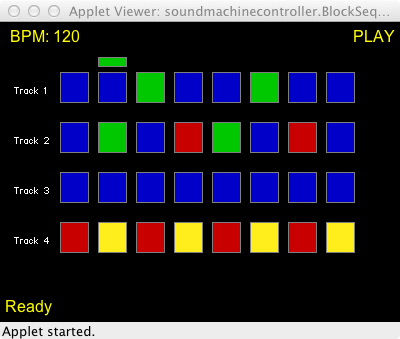
SoundMachine is a LEGO drum sequencer that “builds” music using standard LEGO bricks. SoundMachine is an interactive music tool to collaboratively develop music. SoundMachine scans 2×2 colour LEGO bricks arranged in 4 tracks of 8 beats. The colour information is converted to MIDI messages by a Processing sketch, which sends MIDI to Ableton Live to play the instruments.

Continue reading »



The new LEGO 9398 RockCrawler is out, and I really enjoyed how the designers chose to mount the motors directly on the pendular axles. Looking at it I realised that by replacing the power-function motors with NXT motors I could make the RockCrawler driven by the NXT. I had a new NXT2WIFI sensor from Dani Benedettelli and figured this would be the ideal chance to test it out.

Continue reading »


Simon Burfield has built a prototype for the world’s first powered LEGO wheelchair using LEGO Mindstorms NXT. It uses Rotacaster wheels for multi-direction driving, and is powered by a total of 7 NXTs. I don’t fancy changing the batteries on that after a day out!

Continue reading »


Dexter industries have shown how to use their Dexter wifi sensor, in combination with web sockets, to control a NXT robot directly from an iOS device (iPhone or iPad) or an Android. You can read more at their blog post.

 
Tagged with:  
 

I’ve been a big fan of John’s work at Dexter Industries (as you can tell from how many of his sensors I’ve used in my projects!) Now you can read a great interview with him in Make magazine!



leJOS is also well suited to teaching the basic principles of object-oriented programming; it is Java after all! And what better way to illustrate in concrete terms how powerful Java is than by applying it to building robots?




Building LEGO in Chrome

On 26/06/2012, in News, by Mark


Now you can enjoy hours of Lego building fun right at your desk, building Lego on a virtual map of Australia and NZ directly in your Chrome browser!